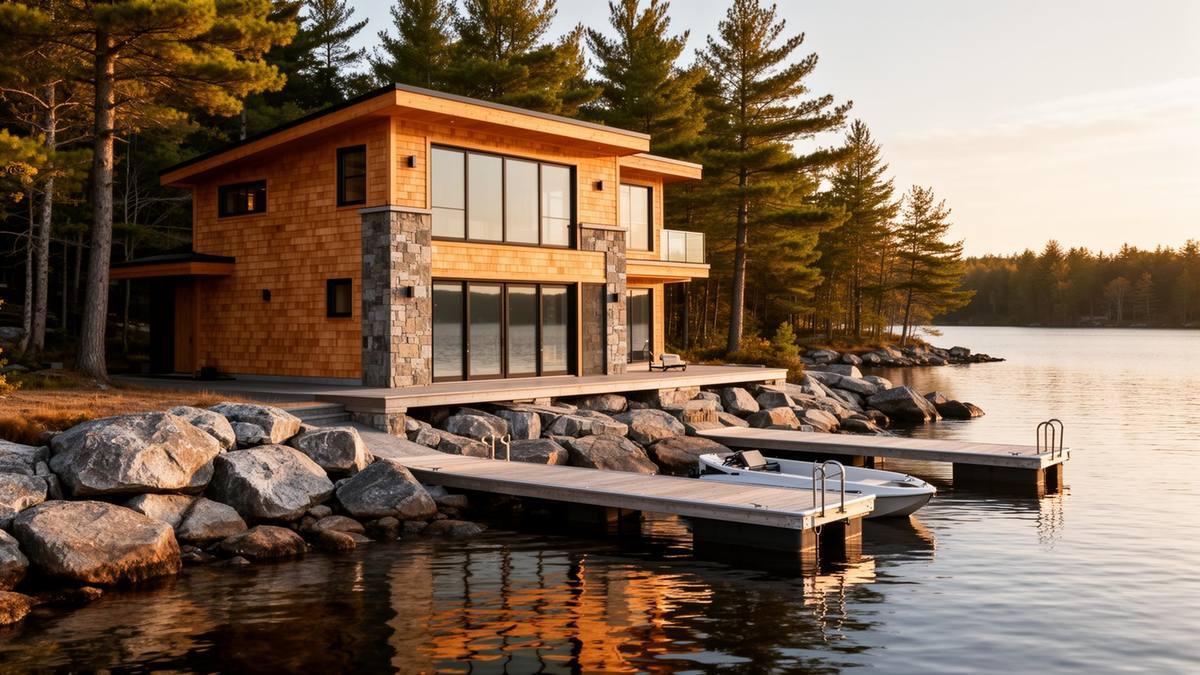
Every year a handful of Muskoka boathouse owners call us with the same question: is it cheaper to fix the existing structure, or to tear it down and rebuild? The financial answer matters, but the bigger factor is usually regulatory. Most existing boathouses in Muskoka are legal non-conforming (they predate current shoreline rules) and losing that status can mean you cannot rebuild the same footprint. This guide walks through how we assess an existing boathouse, what triggers a loss of grandfathered rights, and how we scope repairs versus a full rebuild.
Legal non-conforming: the concept that changes everything
Most Muskoka boathouses more than 20 years old sit closer to the shoreline, extend further into the water, or are taller than what current bylaws permit. They exist legally because they were built before the current rules or under a prior variance. This is called legal non-conforming status, and it is attached to the structure, not the property. Demolish the structure and you often demolish the right to rebuild it in the same footprint.
Township-by-township rules vary. Muskoka Lakes, Georgian Bay, Lake of Bays, and Bracebridge all have somewhat different definitions of how much of a structure can be replaced before it counts as new construction. As a general rule, replacing more than 50 percent of the structural framing (or in some townships, more than a certain percentage of the total value) triggers a review of whether the non-conforming status still applies. This is not a fixed rule and it varies by municipality, so getting written confirmation from the township before starting is a required step on every boathouse project we quote.
The structural assessment
Before we quote anything, we do a full structural walk-through of the boathouse. That includes cribbing or steel piles below water, the deck substructure, the wall framing, the roof structure, and all connections. On older boathouses we often bring in a marine contractor or diver to inspect the cribs from below the waterline, because that is where the worst failures hide.
- Timber cribs: expected life 40 to 80 years depending on wood species and water conditions. Failure mode is bottom rot and cap displacement.
- Concrete cribs: 60 to 100 years. Failure mode is spalling at the waterline and rebar corrosion.
- Steel piles: 40 to 60 years. Failure mode is corrosion at the mud line and cap deflection.
- Wood frame walls: 50 to 90 years if kept dry. Failure mode is bottom plate rot and window opening leaks.
- Roof structure: 30 to 60 years. Failure mode is roof plane sag and ridge line settlement.
The output of the assessment is a scope map: what has to be replaced this decade, what can wait 10 to 20 years, and what is still solid. We take that map and match it against the non-conforming threshold for the specific township.
Repair scopes we see most often
On boathouses where the cribs are still sound but the wood structure above has aged out, a common scope is full re-decking, full re-siding, new roof, new windows and doors, and mechanical upgrades. This typically runs $85K to $180K depending on size and finish level. The building looks new, the structural risk is well-managed, and non-conforming status is preserved.
On boathouses where cribs are the problem, the scope is much larger. Working underwater requires MNRF approval, in-water work permits, often environmental assessments, and a construction window that only opens in specific seasons. Full crib replacement on a two-slip boathouse typically runs $120K to $260K before any above-water work.
When rebuild is the right answer
Rebuild starts to make sense when the assessment finds problems in three or more of the following categories: cribs, primary framing, roof structure, and code compliance (electrical, egress, guardrails). At that point the repair scope grows to a size where it is close enough to a rebuild that the honest question becomes: are we willing to accept the current footprint's limitations, or do we want a modern design?
Rebuild also becomes attractive if the current boathouse footprint does not fit the family's actual use. A single-slip boathouse from the 1960s does not accommodate a modern 22-foot bowrider without scraping the sides. If a rebuild would let you optimize slip width, add second-story space (where permitted), or reconfigure the deck, the rebuild premium may be justified by the outcome.
“The right question is not "repair or rebuild." It is "what do we keep, what do we replace, and what will the township approve when we file the permit?"”
Permit reality in 2026
Boathouse permitting in Muskoka is more constrained now than it was a decade ago. Both provincial (MNRF, DFO) and municipal reviews are slower and more detailed. Repair scopes with clear preservation of non-conforming rights permit faster (often 6 to 12 weeks for municipal approval). Rebuild scopes with any changes to footprint or height can take 6 to 18 months, and are not guaranteed to approve at the size of the existing structure.
This regulatory friction is often the deciding factor. A repair that preserves what you have gets you back on the water in one season. A rebuild is a two-year project when you account for permitting.
Sequencing the work
In-water work seasons in Muskoka are narrow: typically August through October for crib work, subject to fisheries timing windows that vary by lake. Above-water work can happen through the winter on a boathouse if it can be enclosed and heated. On multi-year scopes we plan cribs in one season and structure in the next, using the winter between for framing prefab off-site so on-site time is minimized.
Where the money goes on a typical repair
On a $120K structural repair to a single-slip boathouse:
- Structural framing and re-decking: 24 percent
- Roofing, soffit, fascia: 12 percent
- Siding and trim: 14 percent
- Windows and doors: 10 percent
- Electrical rework and lighting: 8 percent
- Barge, staging, water access: 10 percent
- Permit, engineering, inspections: 6 percent
- Selective crib repair (if scope allows): 10 percent
- Finishing, cleanup, contingency: 6 percent
FAQ
Frequently asked
- Will I lose my legal non-conforming boathouse if I rebuild it?
- Usually yes if you replace more than a certain percentage of the structure. Each Muskoka township defines the threshold differently. Get written confirmation from the township planning office before starting any scope that could trigger a review.
- How long does a full boathouse repair take?
- Above-water structural repair is typically 6 to 14 weeks on site. Any in-water crib work extends the project across two seasons because of the fisheries timing window and the limited work months.
- Can I add a second story to my existing boathouse?
- It depends on the township, the existing footprint, and the setback rules. Some townships permit habitable second-story space, others do not. Height is a separate limit. Every project starts with a planning department review.
- How much does a new boathouse cost in Muskoka?
- A single-slip boathouse without living space typically runs $220K to $380K in 2026. Two-slip boathouses with a deck above run $380K to $650K. Boathouses with habitable second-story space (where permitted) start at $600K and go up quickly.
- Do I need an environmental assessment for boathouse work?
- Anything touching the water requires MNRF review, and in some cases DFO. Repair scopes that preserve the existing footprint and do not disturb the lake bed are usually approved without a full assessment. Anything more invasive triggers longer review.
Planning a project like this?
We build these across Muskoka.
See how our team scopes, prices, and delivers this kind of work, from first site visit through closeout.
See the service