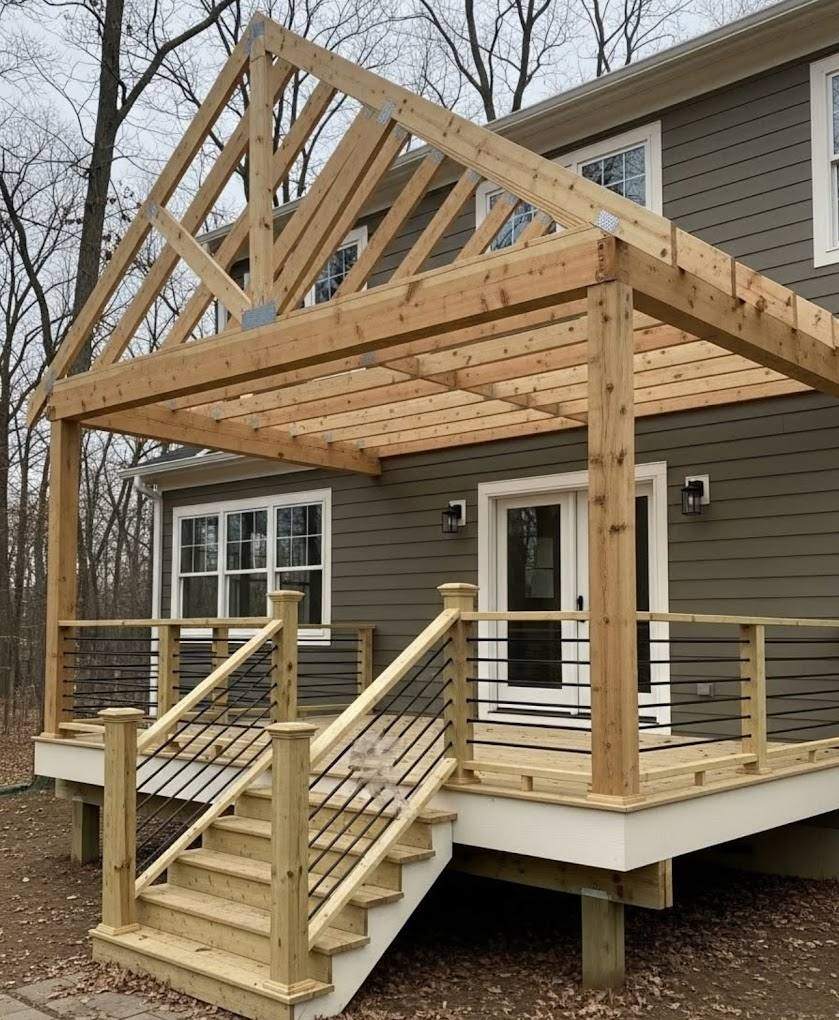
A common call we get in spring: "Our deck feels bouncy," or "I think a joist is soft," or "The stairs pulled away from the deck this winter." The default assumption is often that the whole deck needs to come down. In many cases it does not. The decking boards are frequently still good; the substructure underneath is the failing element. This guide walks through how we assess a deck substructure, which components fail first, and when a substructure refresh is a better option than a full rebuild.
Where cottage decks actually fail
Deck failures are not random. Roughly 80 percent of substructure failures we see happen in one of five places:
- Ledger board attachment to the cottage. Rot at the fasteners, rot in the rim joist behind, failed flashing.
- Post bases at grade. Rotted post ends, corroded connections, footings that have heaved.
- Beam-to-post connections. Cheap or wrong fasteners, split lumber at the notch.
- Rim joists at the perimeter. Water infiltration behind the fascia trim, rot spreading inward.
- Stair stringers where they meet the deck. Water pools at the top of stringers, rot develops from there.
The spring assessment
A proper substructure assessment starts under the deck (not on it). We look at every ledger connection, every post base, every beam-to-post junction. We probe suspicious wood with a screwdriver: sound wood resists, rotted wood gives way. We look at the ledger flashing detail, the fastener types (still in spec or corroded), and the connection between deck framing and cottage rim joist.
On top, we look at the decking for signs that reflect substructure issues: individual boards that flex more than others, bounce underfoot in a specific area, or gaps that have opened between boards where joists have moved. Failed substructure often shows up above before it is visible below.
Ledger repair: the highest-priority fix
A failing ledger is the most dangerous deck problem because it risks separation between the deck and the cottage. Repair scope depends on what has failed. If the fasteners have corroded but the wood is sound, replacement lag bolts or structural screws (with proper flashing) restores the connection. If the rim joist behind the ledger is rotted, the scope grows: siding has to come off, the rim joist has to be replaced, new flashing installed, and the ledger re-attached.
On decks where the ledger was installed without proper flashing (very common on 1980s and 1990s cottages), we recommend proactive replacement even if no active leak has shown up yet. It is a matter of when, not if, the ledger fails.
Joist replacement: individual or wholesale
Individual joist replacement is straightforward if the joist is accessible from below and the decking above can be temporarily supported. Cost per joist is a few hundred dollars each. Wholesale replacement (all joists at once, either from above with decking removed or from below with the substructure jacked and rebuilt) is a larger scope but sometimes the right call.
- Fewer than 25 percent of joists failing: individual replacement.
- 25 to 50 percent failing: consider wholesale substructure replacement while keeping decking.
- Over 50 percent failing: full deck rebuild is usually the honest scope.
Post and footing failures
Rotted post ends at grade are usually cheap to fix if caught early. Sister a new post, transfer the load, cut out the rotted section, install a proper post base that holds the new post off the concrete. Cost is $400 to $900 per post depending on access and finish work.
Heaved footings are a bigger problem. If the footing has moved because it was not below frost depth, the fix is to excavate and replace the footing to proper depth. This typically means jacking the beam, doing the footing work, and then re-setting the beam and post. Cost is $1,500 to $3,500 per footing.
Preserving good decking during substructure work
If the cedar or composite decking is still in good shape, it can be numbered, carefully removed, and reinstalled after the substructure is refreshed. We label every board on removal so it goes back in the same place. Some boards will not survive removal (older fasteners break out the wood); we have replacement boards on hand to match.
The economics: refreshing the substructure and reinstalling existing decking usually saves 30 to 45 percent compared to a full deck rebuild. This is worth doing when the decking has another 10 to 15 years of life. It is not worth doing when the decking is at end of life anyway.
“A deck is not one thing; it is a substructure plus a surface. When one fails and the other is still good, we do the honest scope. Not the easy quote.”
What a substructure refresh costs
A typical mid-size cottage deck substructure refresh (ledger, new post bases, sister some joists, keep the decking) runs $12K to $28K depending on deck size, elevation, and access. A wholesale substructure replacement with decking preservation runs $25K to $55K. Full rebuilds start at $45K and go up from there.
Timeline
Substructure refresh is typically 4 to 10 working days on site. If decking is being removed and reinstalled, add 2 to 4 days. Full substructure replacement is 8 to 15 days.
FAQ
Frequently asked
- How do I know if my deck substructure needs work?
- Signs to watch for: bouncy or soft spots when walking, gaps opening between boards, stairs pulling away from the deck, rusty or missing fasteners visible from below, any wood at grade that gives way when probed with a screwdriver. Any of these warrants a proper assessment.
- Can we keep the existing cedar decking and just replace what is underneath?
- Often yes, if the decking has another 10+ years of life. We label and remove boards carefully, refresh the substructure, and reinstall. Some boards will not survive removal and are replaced. Saves 30 to 45 percent vs full rebuild.
- How long do cedar decks last in Muskoka?
- Well-built cedar decking on a well-built substructure lasts 25 to 35 years. Substructure failures often show up before the decking wears out, which is why a substructure refresh is a common scope on 15 to 25-year-old decks.
- Do we need a permit for deck substructure repair?
- Emergency structural repair to make a deck safe usually does not require a permit. Any wholesale replacement of joists, beams, or posts does. We handle permits as part of any significant scope.
- What causes a deck to feel bouncy?
- Usually one of: undersized joists (never enough for the span), joist spacing that has spread over time, joists that have sagged from rot, or connections between joists and beams that have loosened. Assessment identifies the specific cause and the appropriate fix.
Planning a project like this?
We build these across Muskoka.
See how our team scopes, prices, and delivers this kind of work, from first site visit through closeout.
See the service