Cabinetry and countertops usually account for more than half a kitchen budget, and they are the two decisions clients feel least equipped to make. Showrooms are not much help, because everything looks good under showroom lighting and the salesman has no opinion about how a finish behaves after four winters of woodstove heat and a summer of wet hands. This is what we tell clients, in the order we tell them.
Cabinetry: the box matters more than the door
Everyone shops doors. The door is the part you see, and it is also the part that can be replaced in fifteen years for a fraction of the cost of a kitchen. The box is the part that decides whether the kitchen is still square and solid in twenty years, and it is invisible, which is exactly why it is where cheap kitchens cut.
What to ask about the box
- Material. Plywood boxes cost more than particleboard and are worth it in cottage country, where humidity swings hard between a closed-up winter and a humid August. A particleboard box that gets wet under a sink does not recover.
- Thickness. Three-quarter inch sides hold hardware and heavy stone better than half inch. Ask; it is rarely volunteered.
- Drawer boxes and slides. Dovetailed plywood drawer boxes on full-extension soft-close undermount slides are the standard worth holding out for. This one detail separates a kitchen that feels expensive from one that feels like a rental.
- Adjustability. Six-way adjustable hinges mean your doors can be brought back into alignment in year eight. Cheap hinges cannot.
Painted or stained: this is a Muskoka question
In a city kitchen this is purely aesthetic. In a cottage it is partly practical, because painted and stained finishes age very differently in a building that swings between damp and bone-dry.
Painted
Painted cabinetry gives you the crisp, calm look most clients arrive wanting, and it lets you use a colour rather than whatever the wood happens to be. The honest downside is movement: paint sits on top of wood, and wood moves. On a five-piece painted door you will eventually see hairline lines at the joints. This is normal, it is not a defect, and it is more visible in a seasonal building than in a climate-controlled one.
Two ways around it: a factory-finished conversion varnish or catalyzed lacquer, which is far more durable than anything brushed on site, or an MDF door, which will not move at all and takes paint beautifully. MDF has an unearned reputation as a downgrade; for painted doors it is genuinely the better substrate as long as it never gets soaked.
Stained and natural wood
Stained wood hides movement, wear and cottage life better than any painted finish, which is why it never really left Muskoka. White oak, rift-cut for a quieter grain, is the material of the moment and it deserves the attention: it is hard, it takes a natural or lightly toned finish well, and it sits properly beside pine ceilings and fieldstone.
The mix that actually works
The most successful cottage kitchens we build are usually not all one or the other. Painted perimeter, wood island. Or painted uppers with a wood range wall. The mix breaks up what would otherwise be a large expanse of a single colour, and it lets you put the durable material where the abuse happens.
Door styles, briefly and honestly
- Shaker. A flat centre panel in a square frame. It has been the default for fifteen years for a good reason: it reads traditional or modern depending on everything around it, and it will not date badly. A narrow two-and-a-half inch rail reads more current than a wide one.
- Slab. Flat, no frame. Modern, easy to clean, and in a wood veneer it lets the grain run across the whole run. It can feel cold in a cottage unless it is in wood rather than paint.
- Beaded inset. Doors set flush inside the frame. The most expensive to build and the most beautiful when done right, but it demands a stable environment: inset doors in a cottage that swings from freezing to humid will stick some seasons.
- V-groove and board-and-batten. The cottage-vernacular options. Lovely on an island or a hood surround, heavy if used on every door in the room.
Countertops: the four real options
Quartz (engineered stone)
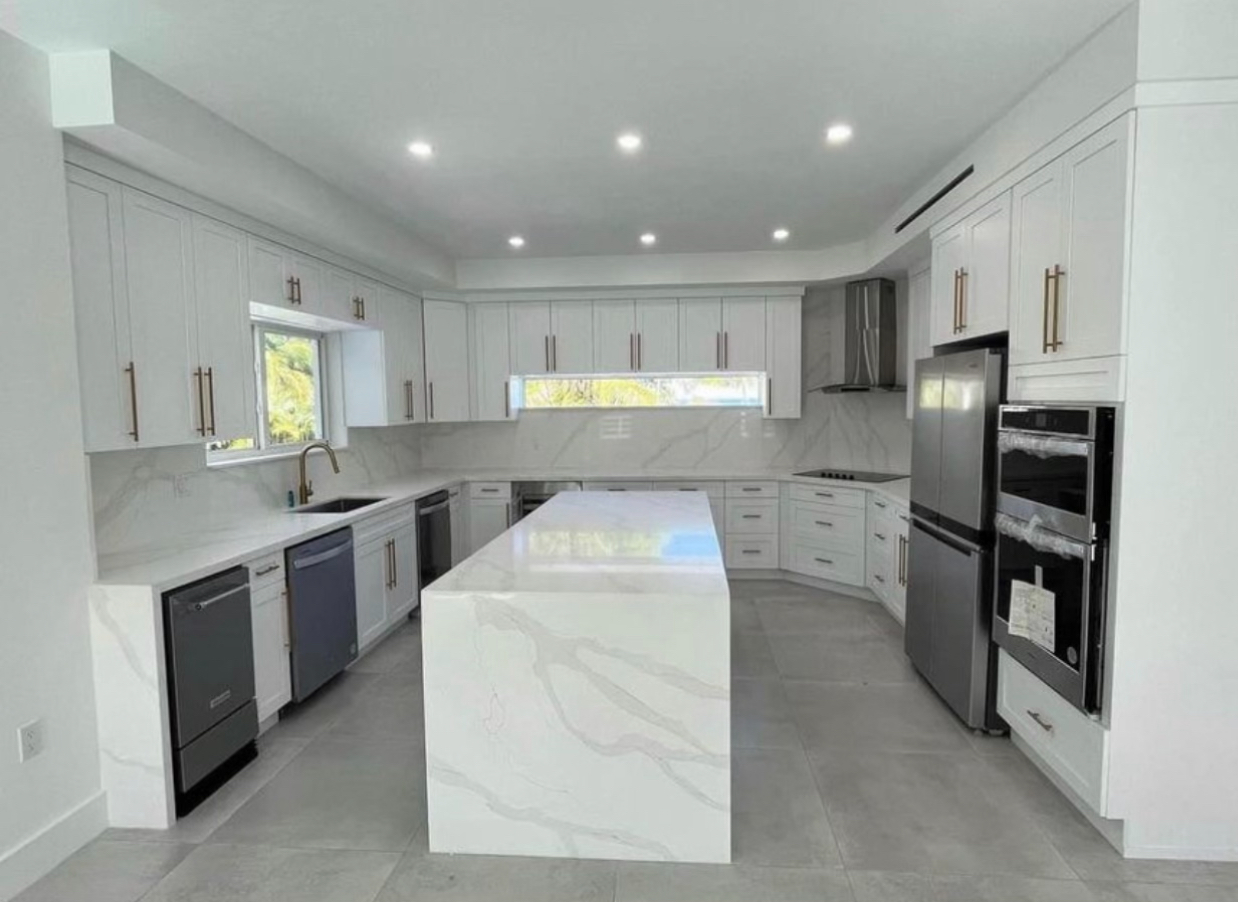
Non-porous, needs no sealing, consistent from slab to slab, and available in patterns that convincingly imitate marble. It is the default recommendation for most Muskoka kitchens and it deserves to be: it is the lowest-maintenance surface you can buy for a house that sits empty half the year.
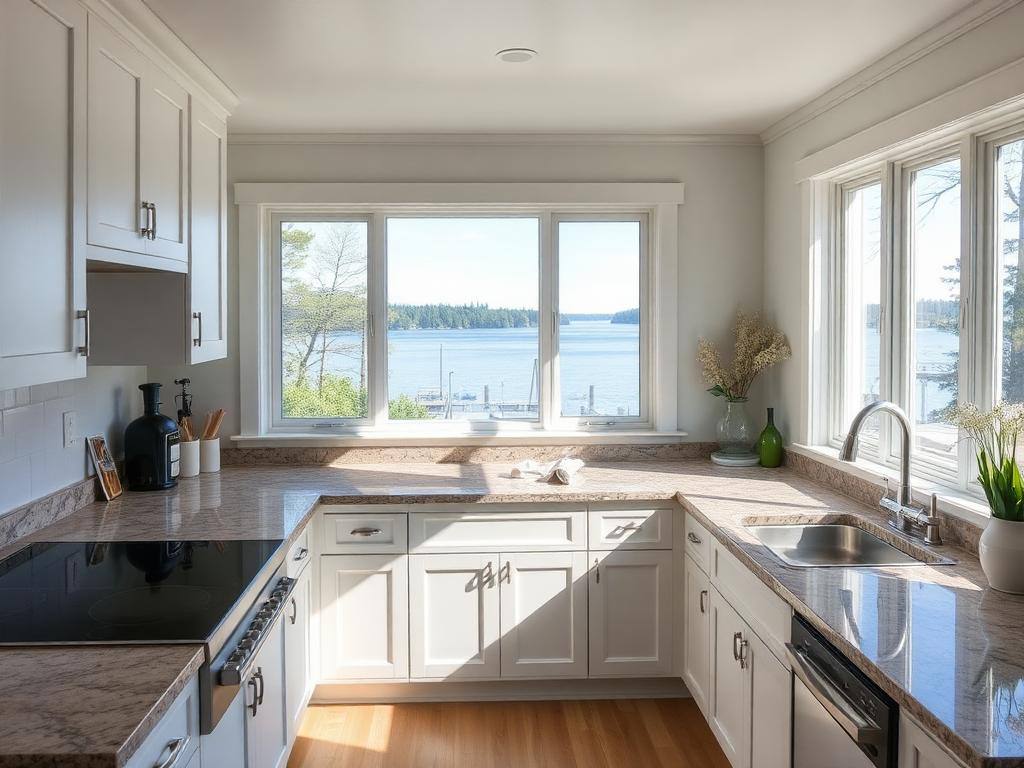
Two cautions. Quartz can scorch, so it wants a trivet under a hot pan, which matters in a cottage where guests do the cooking. And prolonged direct sun can fade some products, which is a real consideration on a south-facing lake wall.
Granite
Out of fashion and unfairly so. Granite is harder than quartz, shrugs off heat entirely, and in the quieter honed or leathered finishes it looks nothing like the speckled slabs everyone remembers from 2006. It is porous, so it needs sealing every year or two, which is a five-minute job.
Marble and natural marble-look stone
The most beautiful surface in the room and the one that demands the most acceptance. Marble etches when it meets anything acidic, and it stains. Owners who love marble love the patina. Owners who want it to look new forever will be unhappy within a season. In a shared cottage where guests cook, we usually steer clients to marble on the island or a baking surface and quartz where the work happens, which gets the look without the anxiety.
Butcher block and solid wood
Warm, comparatively inexpensive, and completely at home in a cottage. It wants oiling, it will show knife marks, and it should not be the surface immediately around the sink unless you are diligent about standing water. As an island top, a bar, or a coffee run it is one of the best value decisions in the kitchen.
Edge profiles, thickness and the details that read expensive
Three details do more for how a countertop reads than the material choice:
- Thickness. A two centimetre slab with a mitred edge built up to look three or four centimetres thick gives you presence without the cost of a solid thick slab.
- Edge profile. A simple eased or square edge looks current. Ogee and bullnose profiles are the fastest way to date a new kitchen.
- Seam placement. Ask where the seams will fall before the slab is cut, and insist they land somewhere other than the middle of the island. A good fabricator will walk the slab with you.
Backsplash, and how far to take it
The full-height slab backsplash behind the range is worth the money: it is the wall that gets splattered and the one people look at. Elsewhere, tile is cheaper and gives you texture. Zellige and handmade-look tiles suit cottage rooms because the irregularity reads as craft rather than error, but they are harder to clean than a flat glazed tile, so keep them away from the range if that bothers you.
“Spend on the boxes, the drawer hardware and the counter you work on. Save on the doors you can replace, the backsplash away from the range, and any decorative moulding nobody will notice.”
Where we tell clients to spend and save
- Spend: plywood boxes, dovetail drawers, soft-close undermount slides, the counter on the main working run, task lighting, and the range hood.
- Save: glass-front display cabinets, elaborate crown, secondary backsplash areas, and pot fillers.
- Decide with your eyes open: marble, inset doors, and open shelving. All three are wonderful and all three ask something of you.
If you want a second opinion on a quote you already have, we are happy to look at it. Most kitchen renovations we price in Port Carling and across the lakes come down to three or four decisions of exactly this kind, and getting them right costs nothing extra.
FAQ
Frequently asked
- Are painted cabinets a bad idea in a cottage?
- No, but choose the substrate carefully. A factory-applied catalyzed finish on MDF doors will not show the seasonal joint lines that a painted five-piece wood door eventually will in a building that swings between damp and dry.
- Is quartz or granite better for a Muskoka kitchen?
- Quartz for low maintenance and consistency, granite if you want a surface that handles heat without a second thought and you do not mind sealing it every year or two. Both outlast the kitchen around them.
- Can I put marble in a cottage kitchen?
- You can, as long as you accept etching and patina as part of the material. A common compromise is marble on the island where it is seen and quartz on the working run where the cooking happens.
- How long do custom cabinets take to arrive?
- Eight to fourteen weeks from the day the order is signed, longer for specialty finishes. Cabinet lead time, not construction, is what usually sets the start date for a kitchen project.
- What is the most common place people overspend in a kitchen?
- Decorative millwork and glass-front display cabinetry. Both add cost per linear foot and neither improves how the kitchen works. The same money spent on drawer hardware and lighting changes the kitchen every day.
- Is white oak worth the premium?
- In a cottage, usually yes. It is hard, it takes a natural finish well, it hides wear better than paint, and it sits comfortably with pine, stone and lake light in a way that trend colours do not.
Planning a project like this?
We build these across Muskoka.
See how our team scopes, prices, and delivers this kind of work, from first site visit through closeout.
See the service In port carling