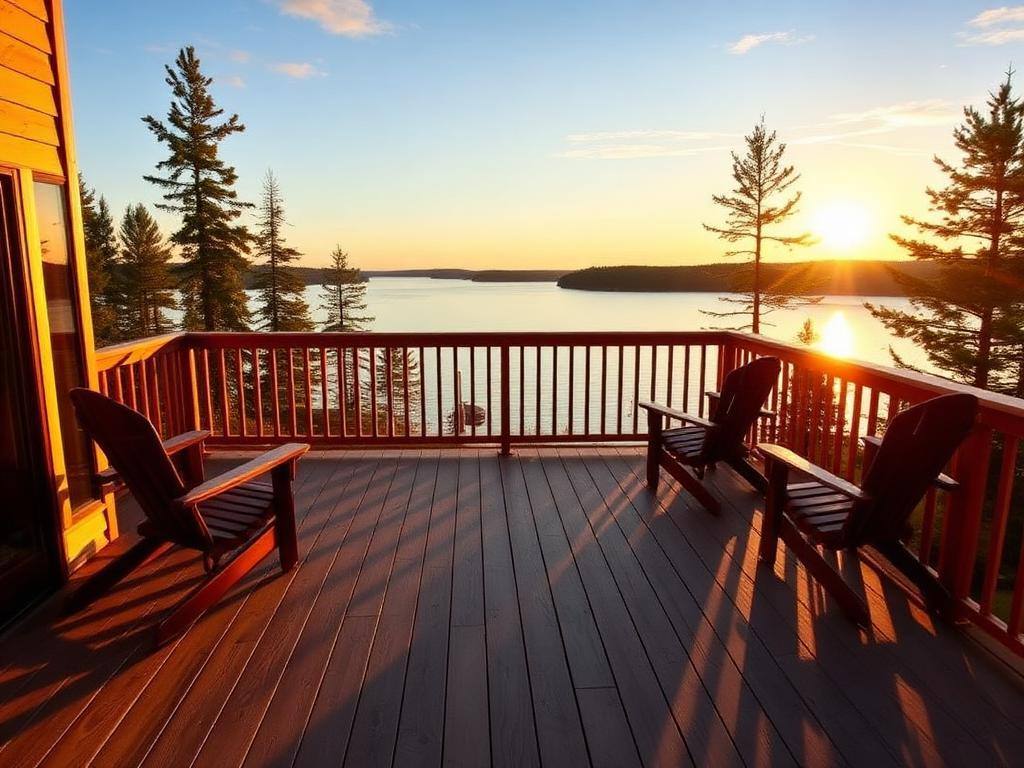
Almost every cottage renovation touches the deck. It is where the cottage meets the lake, it is where the summer actually happens, and it is the single most exposed surface on the property. Cedar and composite are both legitimate answers on a Muskoka shoreline. The choice comes down to who uses the cottage, how it gets used, and how you feel about spring maintenance.
What both share underneath
A deck is a system. The boards are the last thing you pick. Before that comes the substructure, and this is where most Muskoka decks fail. Freeze-thaw, ice load, snow load, and standing water at the deck-to-house intersection are punishing.
Every deck we build, cedar or composite, gets the same substructure spec:
- Pressure-treated joists, brown-treated to ground contact rating (UC4A minimum).
- Joist tape (Trex Protect or DeckWise G-Tape) on every joist top and ledger.
- Stainless steel or triple-coated ceramic-coat structural screws for connections.
- Flashed ledger with kick-out flashing above, drip cap below, spaced fasteners.
- Helical piles or engineered sonotubes to below frost depth (4 feet minimum in Muskoka).
- Positive drainage away from the cottage, always.
Cedar: the traditional Muskoka answer
Western Red Cedar is what cottage decks were built with for a hundred years, and the reason is not sentiment. It is naturally rot-resistant, dimensionally stable, sits well in Ontario climate, and it smells like a cottage should on a hot afternoon.
How cedar ages
Left alone, cedar silvers to a soft driftwood grey within two summers. Some cottage owners love this look and never stain again. Others prefer to hold the warm honey colour with a penetrating oil (Sansin, Sikkens Cetol SRD) applied every 2 to 4 years. Never film-forming (deck stain or paint) on horizontal cedar. It cracks, peels, and traps moisture underneath.
What cedar costs
- Boards installed: $35 to $55 per sq ft of deck surface.
- Cedar railing: $85 to $130 per linear foot.
- Oil refresh: $2 to $4 per sq ft every 2 to 4 years.
Where cedar wins
- Traditional or heritage cottage, especially with a cedar shake roof or cedar siding.
- Owner who enjoys spring maintenance and treats it as part of opening the cottage.
- Large deck on a tight budget, where the material cost difference is real.
- Docks and boathouse decks that benefit from natural rot resistance.
Composite: the low-maintenance answer
Modern capped composites (Trex Transcend, TimberTech AZEK Vintage, Deckorators Voyage) are a real category shift from the first-generation composites of the early 2000s. The capstock (a PVC or polymer shell over a composite core) is what solved the fading, staining, and mould problems the old boards had.
How composite ages
Very little visible change over 15 years. Colour shift within the first six months of UV exposure, then stability. No staining, no oiling, no sanding. Wash it once a year with soapy water. That is the maintenance spec.
What composite costs
- Boards installed: $55 to $90 per sq ft depending on line and colour.
- Composite or aluminum railing: $110 to $180 per linear foot.
- Maintenance: essentially zero, budget $0.50/sq ft/year for washing.
Where composite wins
- Rental cottage where you cannot schedule maintenance around bookings.
- Family with young kids running barefoot: no slivers, and lighter colours stay cooler than dark cedar.
- Modern lake house architecture where a clean, uniform surface matches the design.
- Owners who want to hand the cottage to the next generation without a maintenance burden.
“If the cottage is a rental or the owners live out of country nine months a year, we push toward composite every time. The maintenance window on cedar is unforgiving, and a neglected cedar deck is worse than a well-loved one.”
Lifecycle cost, honestly
Twenty-year comparison for a 500 sq ft deck with railing:
- Cedar: installed cost around $35,000, plus roughly $10,000 in oil and light board replacement over 20 years. Total 20-year cost around $45,000, and you likely have to replace 15 to 25 percent of boards.
- Composite: installed cost around $50,000, plus roughly $1,500 in washing supplies and occasional fastener replacement. Total 20-year cost around $52,000, boards almost always original.
The cost gap over 20 years is not as wide as the day-one number suggests. Composite is a small premium for a much smaller maintenance window. Cedar is a smaller upfront cost with a real annual commitment.
Railing choices
Railing is often more expensive per linear foot than the deck boards per square foot. The Muskoka default categories:
- Cedar or PT wood picket: traditional, needs the same refinishing schedule as the deck.
- Aluminum picket: clean lines, black powder-coat is standard, no maintenance.
- Glass panel: maximum view, worst maintenance (water spots, bug prints, replacement panels). We use it selectively, usually on view sides only.
- Cable rail: minimalist look, requires proper tension hardware and periodic re-tensioning. Not code-compliant everywhere without a proper top rail.
Fastener systems: hidden vs face-screwed
Hidden fasteners (Camo, Tiger Claw, cortex plugs) give a cleaner finish and eliminate visible screw heads. Face-screwing is faster, cheaper, and easier to service. On cedar we usually recommend face-screwing with color- matched stainless. On composite we always use the manufacturer's recommended hidden fastener system, which preserves the warranty.
Muskoka-specific detailing
- Shed rain and snow away from the ledger. A poorly flashed ledger will rot the cottage rim joist inside 10 years.
- Leave 6 inches of clearance under the lowest joist for airflow. Trapped moisture is what kills the substructure.
- Detail for snow load: our snow load in Muskoka is roughly 2.8 kPa design load. Rail and joist sizing has to reflect it.
- Plan for ice dam runoff. A deck directly under a valley without a cricket collects ice and delaminates boards.
- If the cottage is water-access only, factor the barge fee into the material choice. Composite is heavier.
How we make the recommendation
When we quote a deck we ask five questions and then recommend a direction:
- Who uses this deck, and how many months a year?
- Is the cottage rented or family use only?
- How do you feel about spring maintenance?
- What is the architecture: traditional, transitional, or modern?
- What is your 20-year plan for this property?
The answers usually point clearly in one direction. There is no wrong choice between cedar and composite on a Muskoka cottage. There is only the wrong choice for how you actually live at the lake.
FAQ
Frequently asked
- How long does a cedar deck last in Muskoka?
- A properly built cedar deck with a good substructure and regular oiling lasts 25 to 35 years, with some board replacement along the way. A neglected cedar deck (no maintenance, poor drainage) can fail in 10 to 15 years. Substructure is what determines the true lifespan.
- Does composite decking get hot in the sun?
- Yes, all decking heats up in direct sun. Dark composite colours can reach uncomfortable temperatures for bare feet on a 30-degree day. Lighter colours (weathered wood, tropical tones) run 10 to 15 degrees cooler. Cedar in direct sun is comparable to mid-tone composite.
- Can I put composite decking over existing cedar joists?
- Only if the joists pass inspection. Composite manufacturers require joists at 12 or 16 inches on centre depending on board direction, and the joists must be structurally sound with no rot. If the deck is more than 15 years old we almost always recommend a full substructure replacement.
- Do I need a building permit for a deck in Muskoka?
- In most Muskoka municipalities, any deck over 10 square metres or attached to the cottage requires a building permit. Waterfront setback rules from Muskoka District and MNRF also apply, and shoreline decks may need additional review. We handle the permit as part of every deck build.
- What warranty comes with composite decking?
- Most premium composites carry a 25 or 30 year limited stain and fade warranty on the boards. Warranty coverage requires installation to manufacturer spec including approved hidden fasteners and specified joist spacing. We register every board warranty in the owner's name at closeout.
Planning a project like this?
We build these across Muskoka.
See how our team scopes, prices, and delivers this kind of work, from first site visit through closeout.
See the service In muskoka lakes