A Muskoka cottage deck is the outdoor room that gets used more than any inside room from May through October. It also lives outside every kind of Muskoka weather for the other six months. Designing a deck that still looks right in year twenty is a mix of layout decisions, elevation choices, material selection, and structural detailing that most owners never see. This guide walks through each layer.
Start with how the deck actually gets used
A deck design brief starts with three questions: what is the primary activity zone (dining, lounging, entertaining), how many people at peak, and what direction is the sun in the late afternoon. The answers usually push toward a multi-zone deck with a shaded dining area, a lounging area with best-view orientation, and a transition path from the cottage to the water that does not cut through either zone.
The most common mistake is a single-level deck that tries to serve all three functions in one platform. It ends up too small for dining, too crowded for lounging, and the traffic cuts through every conversation. Two or three levels connected by wide, shallow steps solve almost all of it.
Elevation and access
Deck height above grade drives cost, code, and design more than most owners realize. A deck under 24 inches from grade needs no guardrail. Between 24 and 60 inches, code guardrail is required. Over 60 inches, guardrail and often engineered posts. Every transition matters.
On sloped shoreline lots, we often stagger elevations to keep the upper deck at door threshold height and step the lower decks toward the water. Wide shallow steps (deep tread, low riser) read more like landscape than construction and let a deck flow with the terrain.
The substructure decision no one sees
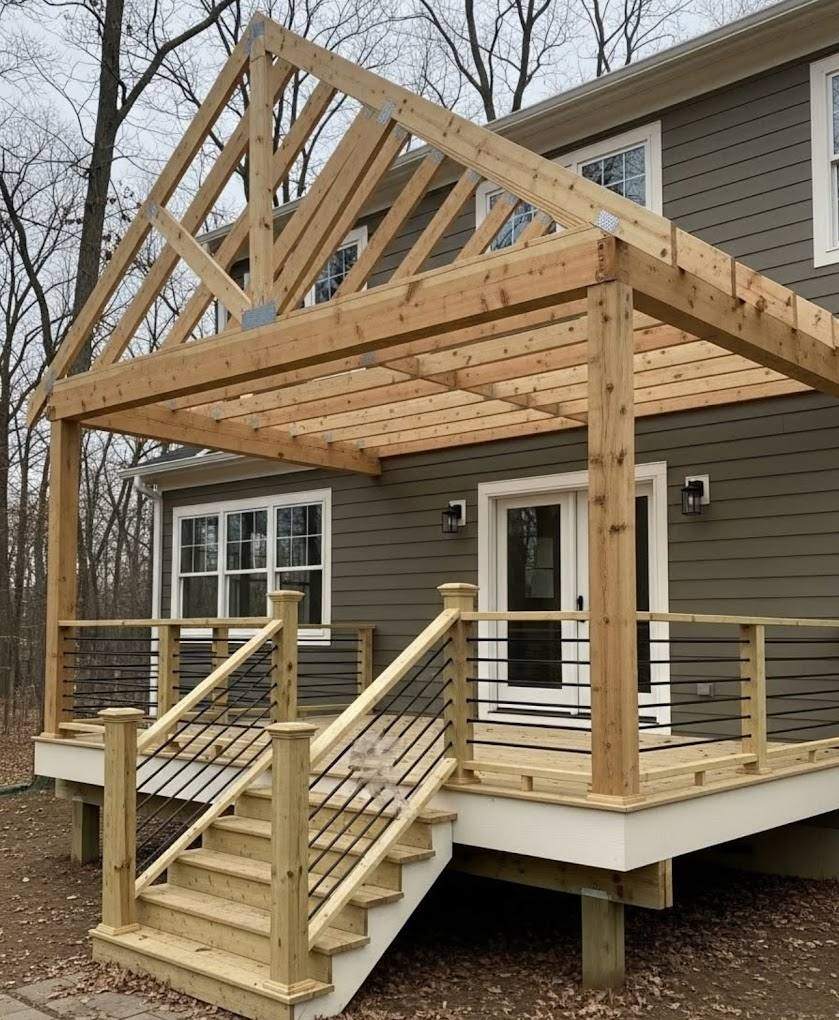
Ninety percent of what determines a deck's lifespan is invisible from the finished surface. Ledger flashing, joist material, post bases, and the connection between deck and cottage all matter more than the decking product itself. A cedar deck on a well-built pressure-treated substructure will outlive a composite deck on undersized joists every time.
- Pressure-treated Southern Yellow Pine joists, 2x8 or 2x10 depending on span, 16 inches on centre for composite or 12 inches for diagonal patterns.
- Galvanized or stainless hardware throughout. No black steel, no plain zinc in a shoreline environment.
- Post bases that hold the post off the concrete or the ground. No post buried in a footing.
- Ledger flashed with a proper Z-flashing that sheds water away from the cottage rim joist. This is where cottages rot.
- Six inches of ground clearance under the lowest joist for airflow.
Decking material: three real options
For Muskoka cottage decks in 2026 we recommend one of three materials, matched to the property and the owner's tolerance for maintenance:
- Western Red Cedar, 5/4 or 2x6 boards, oiled every 2 to 3 years. Classic, warm, and if maintained will last 25 to 35 years. See our cedar-vs-composite piece for more detail.
- Premium capped composite (Trex Transcend, TimberTech AZEK, MoistureShield Vision). 25 to 30-year warranty, no maintenance beyond washing. Costs 40 to 60 percent more upfront than cedar.
- Thermally modified wood (Kebony, Accoya, Thermory). Real wood look with cedar warmth, better rot resistance, lower maintenance than cedar, higher cost.
Railings that do not fight the view
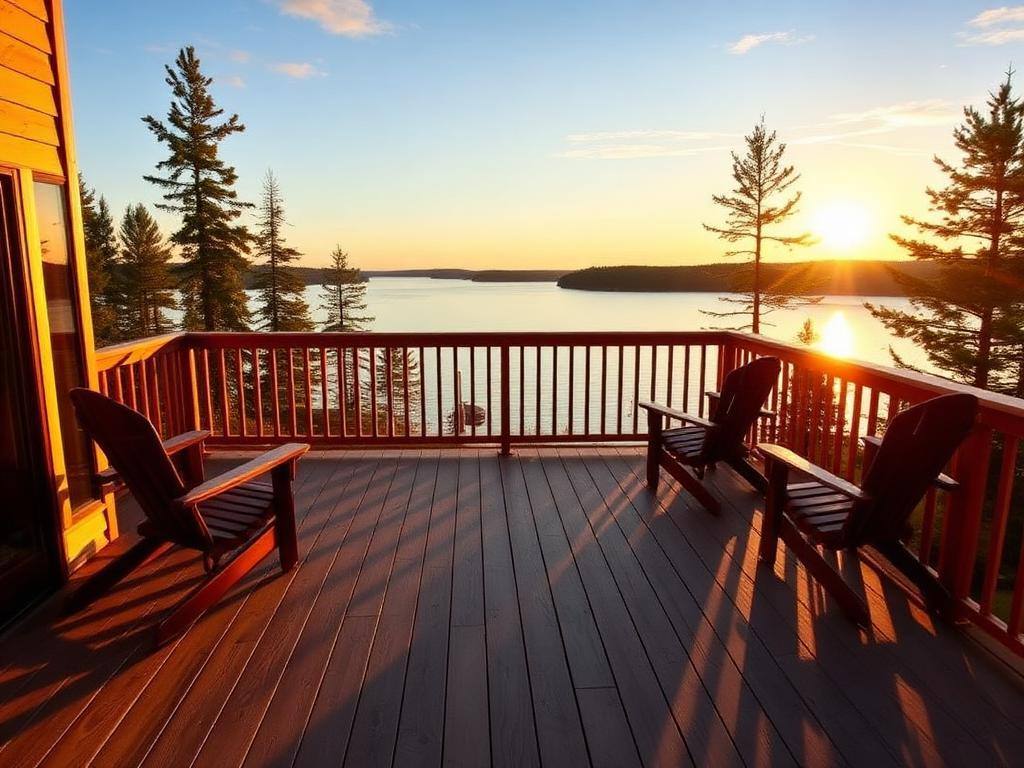
A shoreline deck's rail is either a design feature or a visual obstruction. The two railing types that consistently disappear into the view: cable rail (marine-grade stainless, tensioned properly) and glass rail (tempered, framed or frameless). Both cost 2 to 4 times what a picket rail costs, and both preserve the view that the deck was built for.
Picket rails still make sense in some cottage aesthetics, particularly a traditional cedar cottage where a horizontal cable system would look out of place. Vertical picket, painted black or matched to the fascia, reads clean and does not compete with the lake sight lines the way white picket does.
“The best cottage decks are the ones you do not see when you look at the lake. The rail disappears, the boards fade into the shoreline, and the eye goes past the deck to the water.”
Lighting for cold-month evenings
A deck without lighting is a deck that gets used only until dusk. Layered deck lighting extends the usable season by weeks. Our defaults: post-cap lights at every second post on the rail, low-voltage stair lights on every step riser, and a dimmable overhead source (string lights, pergola-mounted lantern, or soffit-mounted downlights) for the primary seating area.
Snow load and Muskoka winter
Muskoka design snow load is roughly 2.8 kPa. Joists and beams are sized for it, and rails are detailed to handle the lateral load of snow piled against them. What many owners do not think about: decking product choice matters for snow shovelling too. Composite scratches from a metal shovel edge. Cedar shrugs it off. Whichever you choose, use a plastic-edge shovel or a soft-bristle broom on light snow.
Where the budget lands
A well-built 400-square-foot single-level cottage deck with cable rail and cedar decking typically runs $58K to $88K. A multi-level deck with 800 square feet of surface, cable rail, and premium composite decking runs $110K to $180K. Add for engineered substructure over water or unusual grade, for glass rail, and for integrated features like planters, benches, or a pergola.
FAQ
Frequently asked
- How much does a cottage deck cost in Muskoka?
- $85 to $220 per square foot depending on materials, elevation, rail type, and access. A basic pressure-treated ground-level deck sits at the low end; a multi-level cedar or composite deck with cable rail and lighting sits at the high end.
- Do I need a permit for a cottage deck?
- Most Muskoka municipalities require a building permit for decks over 10 square metres or any deck attached to the cottage. Shoreline setback rules also apply. We handle the permit as part of every project.
- How long does deck construction take?
- 2 to 5 weeks on site for most cottage decks once demo (if any) is complete. Multi-level or over-water decks can extend to 6 to 8 weeks. Permit and design typically add 4 to 8 weeks up front.
- What deck material lasts longest in Muskoka?
- A properly built substructure with premium capped composite decking will outlast most cottages: 30 to 40 years of surface life. Cedar on a good substructure lasts 25 to 35 years with maintenance. Thermally modified wood is somewhere in between.
- Can we build a deck around existing trees?
- Yes, with proper framing that leaves room for trunk growth (typically 3 to 6 inches of clearance depending on species) and avoids compaction of the root zone. It is one of our favourite design details when the tree fits the layout.
Planning a project like this?
We build these across Muskoka.
See how our team scopes, prices, and delivers this kind of work, from first site visit through closeout.
See the service