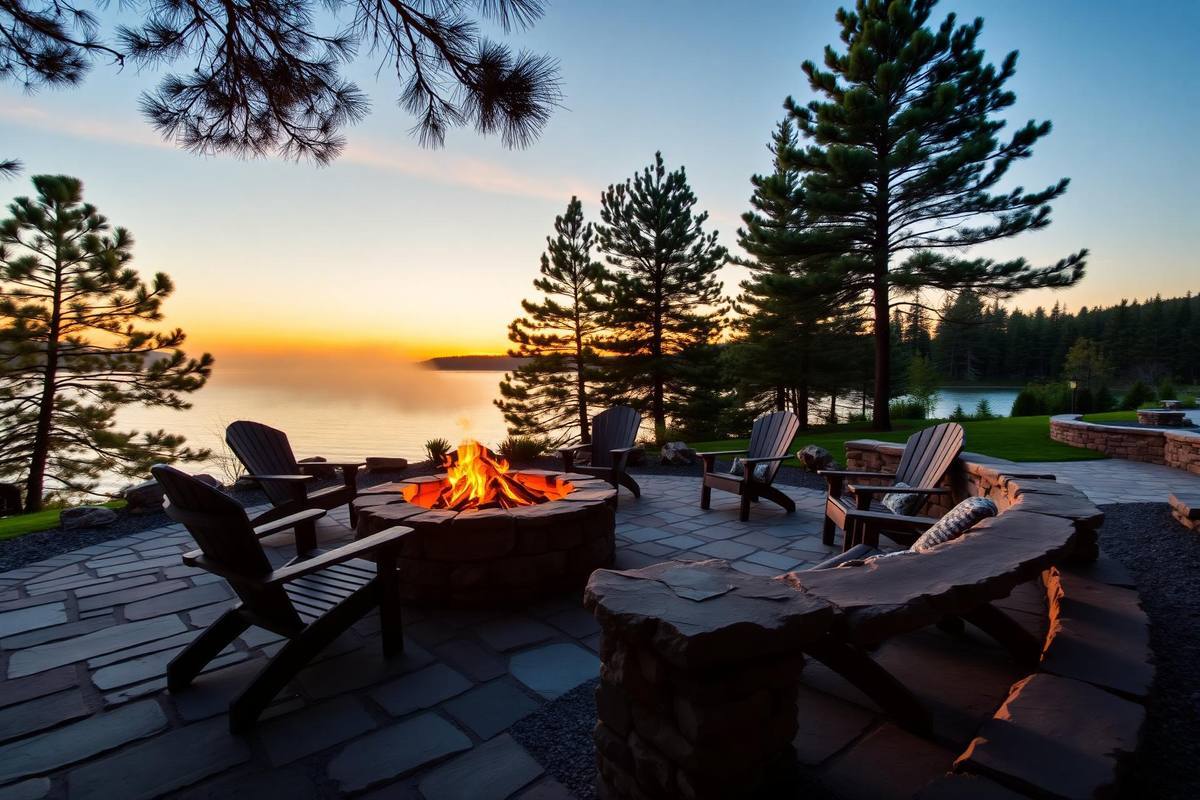
Interlock is one of the most forgiving materials in landscape construction if the base is done right, and one of the most punishing if it is not. Every failing interlock patio we get called to look at is a base problem or an edge restraint problem. The pavers themselves rarely fail. This guide walks through how we install interlock in Muskoka: what the base actually needs to be, why the edge restraint matters more than the joint sand, and what a realistic cost per square foot looks like for a patio that stays flat for 30 years.
The base is 80 percent of the work
A cottage patio in Muskoka needs a 10 to 14-inch compacted base of 3/4-inch clear stone (or 5/8-inch minus for base with proper compaction). That is not a suggestion; it is what stops the patio from heaving in freeze-thaw cycles. Cottage builds where the base is 4 inches of screenings and a bit of clear stone are the ones we get called back to replace 6 years later.
Compaction happens in lifts: 3 to 4 inches at a time, each lift compacted with a plate compactor sized to the material and the project. Skipping this and dumping 12 inches of stone in one layer produces a patio that settles unevenly for years. Every properly built interlock installer knows this. Every fast one skips it.
Drainage: not optional, ever
Interlock is technically a permeable surface but only if the base under it drains. On most Muskoka sites we install a perimeter drain (4-inch perforated pipe wrapped in geotextile) at the base of the excavation, sloped to daylight or to a catch basin. Without this, the base becomes a saturated reservoir that freezes and heaves every winter.
- Base slope of 1 to 2 percent away from any building.
- Perimeter drain at base grade wrapped in geotextile.
- Geotextile separation layer between subgrade and base stone on soft or clay soils.
- No downspout discharge directly onto the patio. Redirect to a rock pit or lawn.
Edge restraint: the invisible failure point
The perimeter of an interlock patio has to be restrained. Either a concrete curb, a proper plastic edge restraint spiked at 12-inch intervals into the base, or an integrated stone border. Without restraint the outermost row of pavers migrates outward over time, and once one row moves, the pattern goes with it.
Paver selection: what matters for cottage life
Not every paver is appropriate for a Muskoka cottage patio. Freeze-thaw rating matters, texture matters (slippery paver near a hot tub is a problem), and color depth matters (some pavers are only surface-coloured and fade unevenly under wear).
- Full-thickness colour pavers from a reputable manufacturer (Techo-Bloc, Unilock, Belgard, Permacon). Freeze-thaw rated for northern climates. 25 to 30-year manufacturer warranties.
- Textured non-slip surface for anywhere near water: shoreline access, pool deck, hot tub surround.
- Larger format slabs for a modern look. Require slightly different base preparation because the individual unit is more sensitive to any base irregularity.
Joint sand: polymeric or regular
Polymeric sand (polymer-modified sand that hardens with water after installation) resists weed growth, keeps ants out of the joints, and gives the finished patio a more finished look. It is our default on cottage projects. Regular joint sand is cheaper and easier to top up over the years but requires annual refresh in most installations.
The most common polymeric sand failure is hazing on the paver surface from improper cleanup during install. This is entirely an install problem: proper application, minimal water on the paver surface, quick cleanup of any residue. Cheap installs rush this and the patio looks cloudy for years.
Where interlock is the wrong choice
Interlock does not work on every site. Steep slopes over 10 percent are hard to detail and drain. Sites with active tree roots within 6 to 10 feet will heave the patio as the roots grow. Waterfront sites within splash zone of the lake face constant saturation that most patio bases cannot handle long-term.
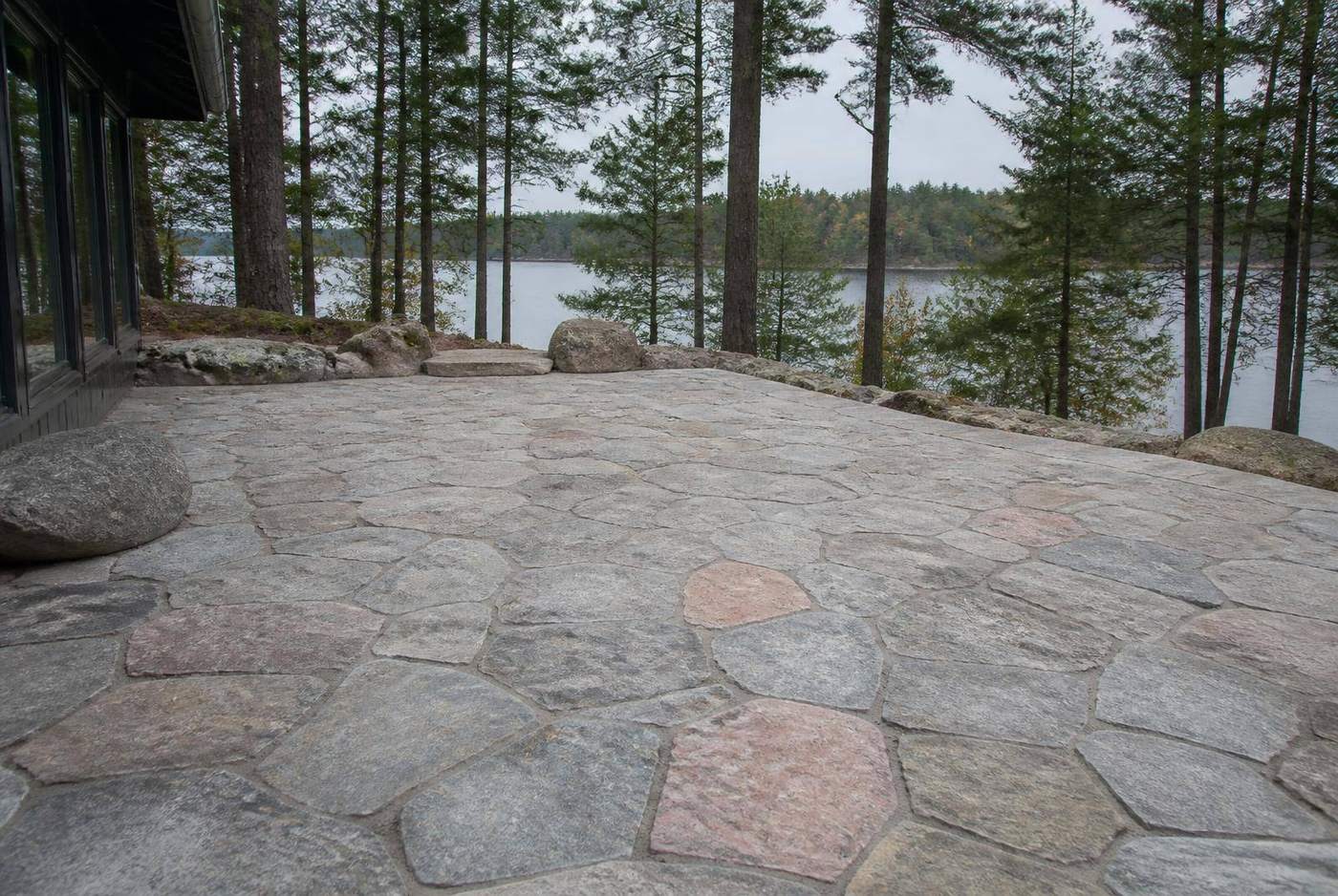
On these sites we recommend natural stone slabs set on a different substructure, or a poured concrete patio, or treated wood decking depending on aesthetic. Interlock is not the universal answer even though it is often quoted as if it were.
“If the quote does not spec the base depth, the compaction method, and the edge restraint, it is not a quote. It is a number.”
Cost ranges
A well-built cottage interlock patio in Muskoka typically runs:
- Standard rectangular pavers, straight patterns, ground-level, 400+ sqft: $30 to $42 per sqft.
- Premium pavers, circular or curved patterns, integrated borders: $42 to $55 per sqft.
- Large-format slabs, complex layouts, sloped or shoreline sites: $50 to $65 per sqft.
- Add for excavation of poor subgrade, for restricted access, and for water-access delivery.
Timeline
A 400-square-foot patio typically takes 5 to 10 working days on site: 2 to 3 days of excavation and base prep, 2 to 3 days of paver install, 1 day of edge restraint and polymeric sand curing. Larger patios scale linearly, plus additional time for complex layouts or integrated features.
Long-term maintenance
Well-installed interlock needs almost nothing for the first 10 years beyond a spring wash. Polymeric sand may need a spot refresh in high-traffic areas around year 8 to 12. If a settling issue appears (usually one localized area), it can often be lifted, the base corrected, and re-set without replacing pavers.
FAQ
Frequently asked
- How much does an interlock patio cost in Muskoka?
- $30 to $65 per square foot depending on pavers, pattern complexity, site conditions, and access. Standard rectangular patios at 400+ sqft on flat ground are at the low end. Complex layouts, large-format slabs, and difficult sites are at the high end.
- How long does an interlock patio last?
- 30 to 50 years with proper base and edge restraint. The pavers themselves are effectively permanent; failures are almost always base or edge issues. A patio that fails in under 10 years was installed with base shortcuts.
- Can interlock be installed over an existing concrete patio?
- Sometimes, if the concrete is structurally sound, drains properly, and the extra height does not conflict with door thresholds. More commonly we recommend removing the concrete and doing a proper base, because a failing concrete slab under interlock is a hidden problem.
- Do I need a permit for a patio?
- Most Muskoka municipalities do not require a permit for a ground-level patio, but shoreline setback and lot coverage rules still apply. We confirm on every project.
- When is the best time to install an interlock patio?
- May through October for excavation and base work. Polymeric sand curing needs temperatures consistently above about 4 degrees Celsius for 24 hours after install. September and October installs are common because summer barbecue season is over and the site is dry.
Planning a project like this?
We build these across Muskoka.
See how our team scopes, prices, and delivers this kind of work, from first site visit through closeout.
See the service